Spanish Cuisine
Empanada Gallega
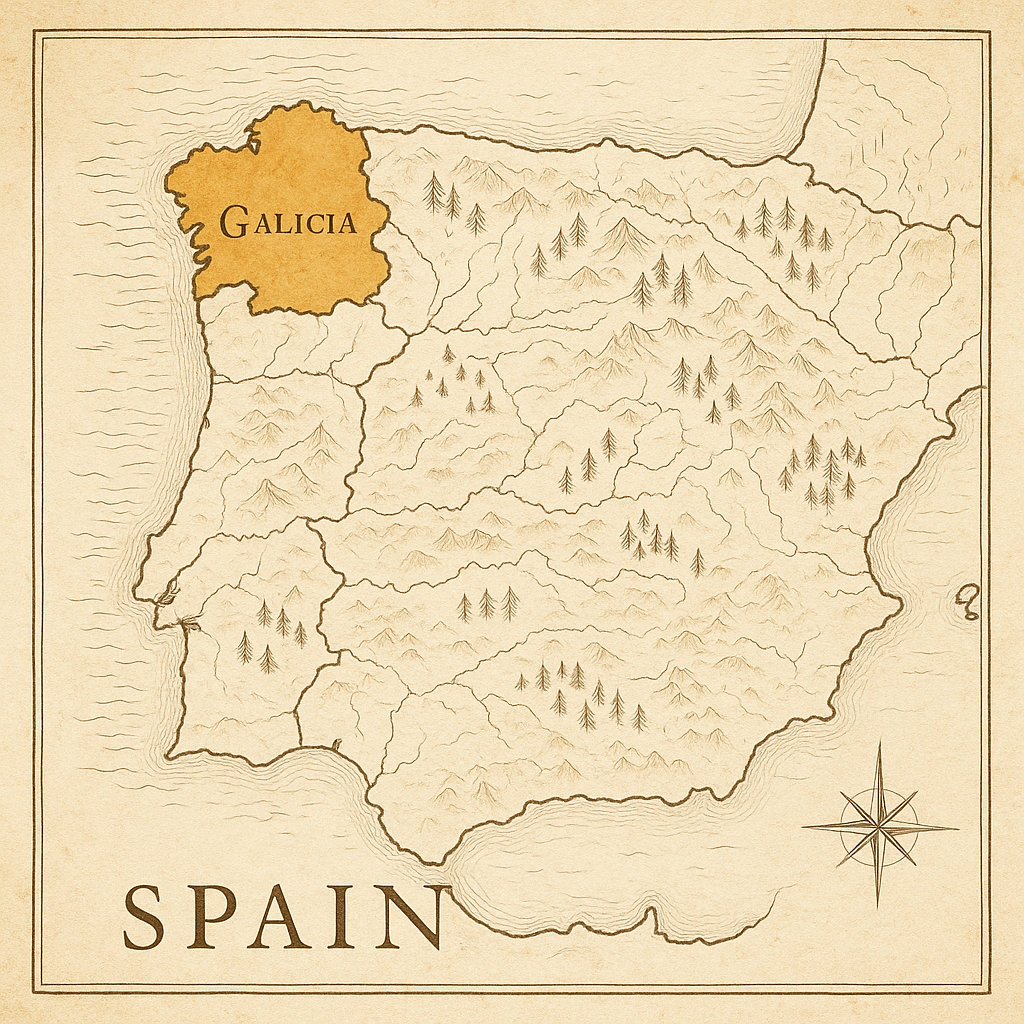
Galicia's great savoury pie. A thin olive-oil dough filled with a slow onion and pepper sofrito and good tinned tuna, baked flat and eaten at any temperature.
- Prep
- 45 min (plus 1 h rest)
- Cook
- 45 min
- Serves
- 8
- Difficulty
- Medium
Display
History & Origin
The empanada is Galicia's oldest signature dish, older than any written recipe for it. Among the condemned souls carved on the 12th-century Pórtico da Gloria of Santiago's cathedral hangs a glutton condemned to bite forever into an empanada he can never swallow; eight centuries have since worn the pie itself down to a stub at his teeth, but the punishment reads as clearly as ever. The Codex Calixtinus, the medieval pilgrim's guide to the Camino de Santiago, records pilgrims eating empanadas along the way, and the banquet carvings in the archbishop's palace next door show diners tucking into them freely, presumably with clearer consciences. It began as portable food: a sealed pie a field hand or a pilgrim could carry all day and eat cold, without needing a plate or a fire.
The word comes from "empanar", to enclose in bread, and the classic filling is the zaragallada, a slow sofrito of onion, pepper, and tomato that stains the dough orange with its oil. Tuna is the filling the rest of Spain knows best, but in Galicia the pie holds whatever the day provides. Salt cod with raisins, scallops, sardines, octopus. Every village fiesta and family kitchen defends its own version.
See the last few photos in the gallery below for the Portico photos depicting empanadas in Galicia
Ingredients & Instructions
- Start with the filling. Warm the olive oil in a wide pan over low heat, add the onions and peppers with a pinch of salt, and cook slowly for 25 to 30 minutes until completely soft and sweet, without letting them brown. Rushing this step is the most common way empanadas go wrong; the onions need the full half hour to turn sweet.
- Add the grated tomato and paprika and cook for another 10 minutes until thick and jammy. Taste for salt, then tip the mixture into a sieve set over a bowl and let the orange-stained oil drain off. Let the filling cool.
- Make the dough with the drained oil: mix the flour, yeast, salt, and paprika, then add the warm water and 100 ml of the sofrito oil. Knead for 5 minutes until smooth and supple, cover, and rest for about an hour until puffy.
- Fold the tuna and chopped egg through the cooled filling. It should be moist but not wet; a soggy filling means a soggy pie.
- Divide the dough in two, one piece slightly larger. Roll the larger piece into a thin rectangle (3 to 4 mm) and drape it over an oiled baking tray, letting it climb the edges slightly.
- Spread the filling evenly over the base, leaving a 2 cm border. Roll out the second piece and lay it over the top.
- Roll and pinch the edges together into a rope-like seal, cut a small hole in the centre so steam can escape, and decorate the top with any dough scraps if you're feeling festive. Brush all over with beaten egg.
- Bake at 200 °C for 40 to 45 minutes until deep golden top and bottom. Rest before cutting; empanada is at its best warm or at room temperature, and arguably better the next day.
Notes
The sofrito oil in the dough is the trick most recipes outside Galicia skip. It carries the flavour of the filling into the crust and gives it that faint orange tint. If you're short on time, a 500 g ball of bread dough from a bakery works, kneaded briefly with a few spoonfuls of the drained oil.
The Pórtico photo in the history section is a detail of a photograph by P.Lameiro, CC BY-SA 4.0, via Wikimedia Commons.
